The PRK procedure involves removing the surface cells prior to treatment with the laser. The surface cells the grow back over the next 3 to 4 days and form a healing line. As the healing line smooths out vision improves. Rarely, the healing line can fall directly in the center of vision in both eyes [...]
Why Do Some Patients That Have PRK Have Slightly Blurred Vision Longer Than Others?
February 9th, 2012What If I am Not a Candidate for Lasik
January 24th, 2012Four out of ten patients that come to see us are not candidates for Lasik eye surgery. Of these, two can have PRK. So 20% of patients can only have PRK. When we do our monthly statistical analysis we note that we do 50% PRK. This is because 3 out of 10 candidates that qualify [...]
Contemplating Laser Eye Surgery (Part I)
November 29th, 2011If you have worn eyeglasses or contacts most of your life, the possibility of having good eyesight without them may seem remote. But today, high success rates with LASIK and PRK are inspiring more people to seriously contemplate laser eye surgery. A good way to get started is to address these two questions: Am I [...]
An Overview of Laser Vision Correction – Part 3
September 23rd, 2011LASIK and Myopic Correction As explained earlier, patients who are nearsighted have corneas with too much curvature in proportion to the length of their eyes. Once the corneal flap is made and lifted back, the excimer laser reshapes the underlying stroma to achieve a flatter cornea. The surgeon’s carful, precise measurements, which are programmed into [...]
An Overview of Laser Vision Correction – Part 2
August 24th, 2011Photorefractive Keratectomy (PRK) The procedure that originally made wide use of the excimer laser was photorefractive keratectomy (PRK), first performed in 1987. Instead of using a microkeratome to remove the corneal disc, PRK uses the laser to accurately sculpt the cornea one microscopic layer at a time. PRK has seen vast improvements since those early days. PRK [...]
An Overview of Laser Vision Correction – Part 1
April 12th, 2011People have understood the mechanics of eyesight for thousands of years. Writings and drawings on this subject go back as far as 2000 BC. And the quest to correct vision has never stopped. From the invention of eyeglasses hundreds of years ago to the fabrication of the first American contact lenses, the evolution of vision [...]
How the Human Eye Works Part 3
March 9th, 2011Most people who have had an eye exam that includes a test to measure visual acuity, clarity or sharpness of vision, recognize the simple notation 20/20 as meaning “normal vision.” What do those numbers mean? Let’s say your vision is 20/40. That means you can see at twenty feet what a person with normal vision [...]
How the Human Eye Works Part 2
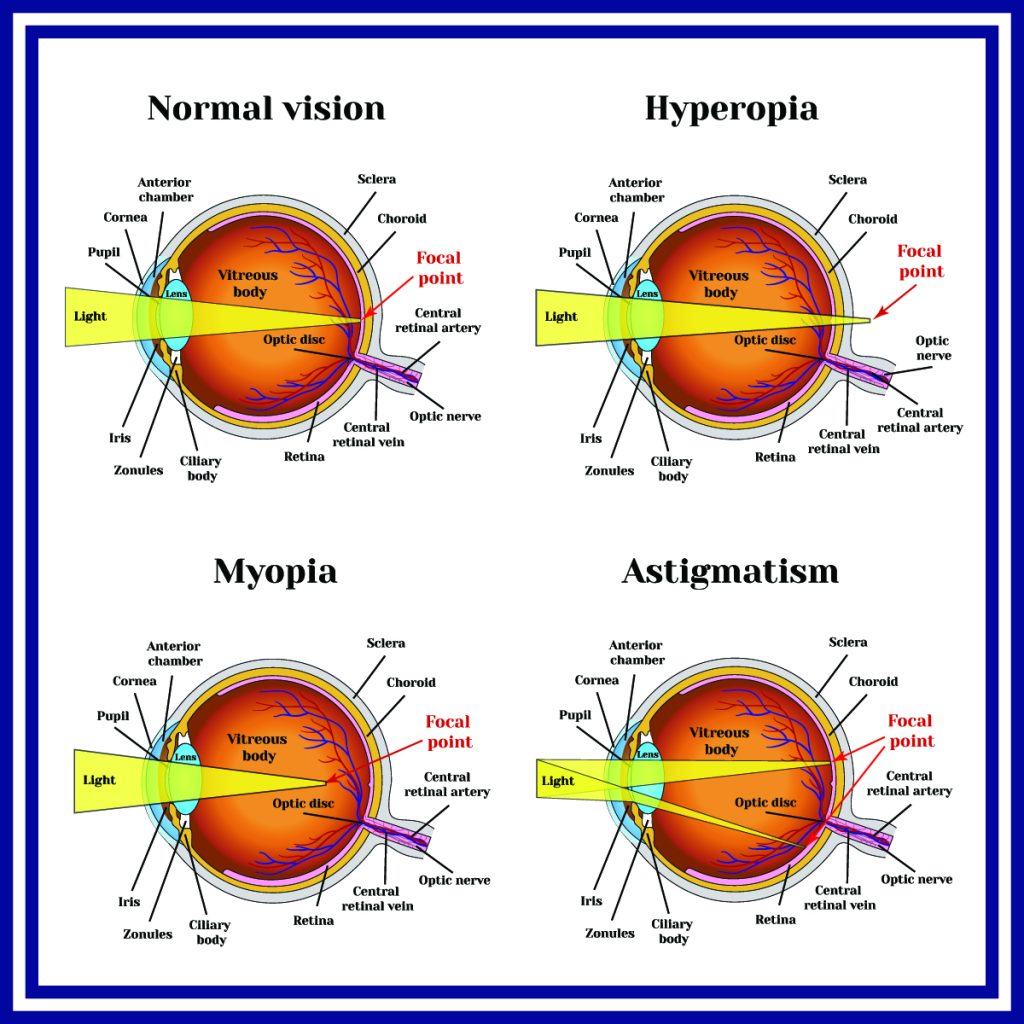
November 17th, 2010Common Vision Problems Your Boston eye doctor may refer to your vision problem as your refractive error, or focusing problem. How well you see is determined, for the most part, by how accurately your eyes are able to bend, or refract, light. In a normal eye, the focus comes to a point on the retina. [...]
How the Human Eye Works (Part 1)
October 19th, 2010Sight is our most precious sense. Our eyes enable us to take in the surrounding world. Without sight, the way we perceive the world would be forever changed. No wonder the eyes are often elevated in literature, art, religion, and philosophy to symbolize everything from the windows of the soul to supreme wisdom. Indeed, the [...]
Choosing A LASIK Surgeon:Questions to Ask Part 2
March 31st, 2010Has the surgeon performed at least 3,000 LASIK procedures and does he/she maintain a database of results? Three thousand cases is a large enough number so that the surgeon will have the database that will yield statistically significant results. The surgeon should be able to provide you with an accurate assessment of what your vision [...]